Tools We Don't Use
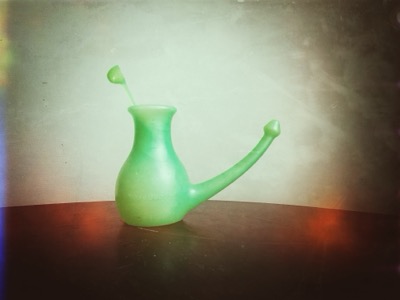
In the picture is a small pot used for nasal rinsing. But today my intention is not to tell you how to use it, what it does, or where the idea comes from. My story is about tools that we have but do not use.
Here is what happened — when the cold weather arrived, I caught a cold. Runny nose, congestion, cough. It was not the new C-disease, just a common cold. I was ill for about 4 days. On the morning of the fourth day, at the breakfast table, among all the other conversations, my father-in-law asked — did I know about the yogic nasal rinsing method and whether I practiced it — he had heard it was good…
Of course I know this method! I bought the pot shown in the picture three years ago. One autumn/spring I diligently used it, with good results, but then it somehow ended up on a shelf, then moved to a more distant shelf, and then… got lost somewhere. And I — simply forgot about the existence of this pot and the rinsing method. Forgot about everything — that such a method exists, that I had done it, that I have the appropriate pot, that when I rinsed regularly it was good, etc., etc. I forgot everything!!!
All along I had a tool at my disposal with which it was possible to prevent the problem — but I not only did not use this tool, I had even forgotten about its existence!!! The same goes for other tools.
Just recently, in conversations with clients in individual consultations, we talked about the same thing — that they know tools, instruments for dealing with their thoughts/emotions/states, but — there are prolonged periods when these tools simply disappear — are half-forgotten, forgotten — and are not used. As a result — problems arise and develop that could have been reduced and prevented, or avoided altogether.
The same applies to the content I teach in courses — foundational mindfulness methods, mind management, cultivation of thoughts and emotions — in most cases, this is nothing new. It is nothing unknown. It is nothing original or unique. These are the old, familiar methods that — we have simply forgotten, and therefore do not use.
What is the way out? To remember that we have tools, we must use them — regularly — because we learn what we repeat. The more often we repeat, the better we learn. Another way out — a new attitude can help — at the moment when there is some problem in my life (an unpleasant health or emotional state), one can deliberately conduct a “tool inventory” — look at what I know about this topic, what tools/methods I have learned in this regard, and which ones could be applied.
Otherwise — we all need reminders. Because we forget. It is better to ask one more time than to remain in the dark. It is better to get past that imaginary shame of “how could I have forgotten such a simple thing” than to remain without help. It is not difficult for me to repeat. I myself forget, I know that my listeners forget. That is normal. Because, after all, the foundation of learning is repetition.
While I am at it — taking the opportunity, let me remind you that the course “Mind Hygiene” will start very soon — on September 1st. It is still possible to sign up. There I will remind about methods for taking daily care of your mind — about what we forget. But perhaps someone will also hear something new!
Topics