Fire Ritual at the Summer Solstice - Let It Be!

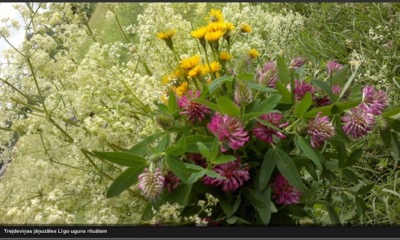
Everyone knows that midsummer herbs must be gathered and that they possess a special power. The meadows themselves invite you to come, wade in, fall into them. The gathered herbs are most often used for - what? Sometimes for teas, sometimes for saunas. Mostly for decoration - ornaments. But this year we tried something new - a fire ritual. Solstice fire rituals have been described elsewhere too - I quickly managed to find them [here](http://www.saulesjosta.lv/modules.php?op=modload&name=News&file=article&sid=359&mode=thread&order=0&thold=0” target=“_blank”) and here. We did it a little differently (we celebrated already on the night of the 21st, so I am writing in the past tense - it has already been done): In the afternoon, but not too long before sunset - around seven - each of the celebrants went to the meadow to gather midsummer herbs. This is done alone, in silence - a kind of meditation. You must gather twenty-seven herbs - three times nine. For each herb - each flower, each plant - you must think of a wish: the first nine - about yourself. The second nine: about your loved ones. (but carefully, for others one should not wish for more than happiness and health). The third nine: about the land, the people, the country, the world. You must remember which herb is for which wish. (Beginners are allowed to write it down.) Later, after sunset, when the bonfire is already lit, at some point everyone takes their bundles of herbs and takes one at a time, remembers silently to themselves, or perhaps says aloud their wish and with the words “Let it be!” throws it into the fire. And so all twenty-seven plants - each one by one. Of course, the original ritual has nuances, details, and all sorts of subtleties, but the basic framework is what I described above. Reflecting on this, what I noticed and understood were several essential things: First, a person is compelled to formulate their wishes - and to think about them at least twice - when picking the herb and when throwing it into the fire. Second - I noticed this in the following days - now a specific plant is associated with a specific wish for me. Walking around my yard, seeing that plant, I will be reminded all summer long of what I wished for - in other words, it is a way of creating an external association. Third - a different purpose for gathering herbs emerges - it is clear how many to pick and what to do with what has been picked. Otherwise (paraphrasing one of the celebrants) usually enormous armfuls of herbs are brought inside or into the yard, and then there is nowhere to put them - they end up discarded in a corner. Fourth - that moment when all the celebrants stood around the bonfire, and each one, repeating their wishes to themselves, threw their herbs into the fire with the words - Let it be! (each one twenty-seven times) - that was one truly powerful moment. Why do I write about this associative link - herb-wish? Because from a psychological perspective it can be explained by the self-fulfilling prophecy mechanism - if a person has a thought about themselves, and it is thought often enough, then the person themselves acts in a way to fulfill that thought. That is why wishes, becoming aware of them, and naming them aloud are so important. Happy Midsummer to all those who are celebrating tonight!